📝 Product description
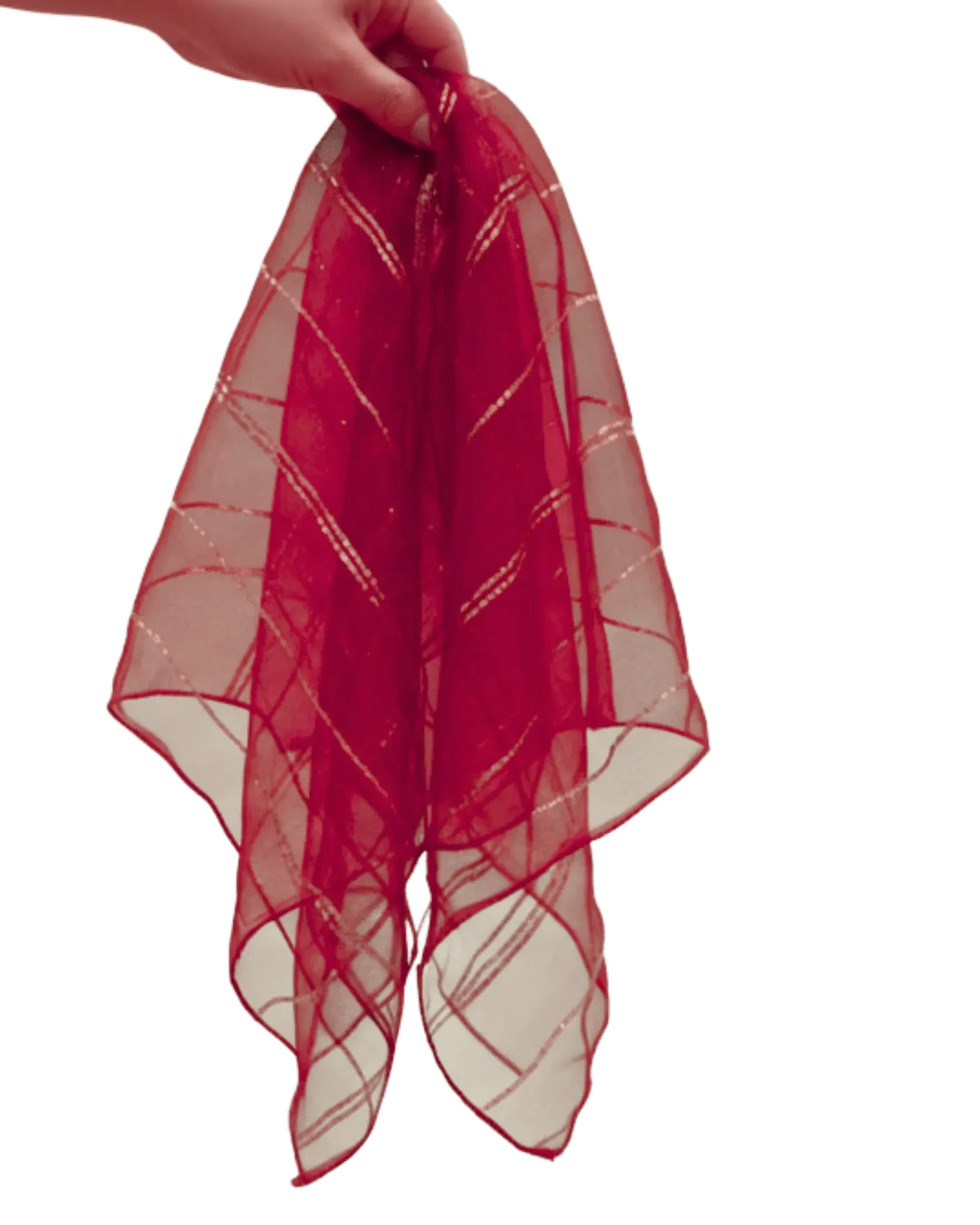
There are accessories that are not only worn but felt. Our traditional Albanian dance cloth – Shamija e Kuqe is exactly that. In a warm, vibrant red with fine golden lines that dance like sparks across the surface, this cloth brings the essence of Albanian festive culture into every movement. When it swings through the air, it catches the light, shimmers softly, and tells – without words – of Kultura jonë, of family, of togetherness, and of the great joy we call "gëzim".
The Shamija is more than fabric; it is an inviting gesture. In the Vallja, the traditional dance, it accompanies every turn, every step, and every smile. Whether at the Darsma (wedding), cultural performances, festivals, or private celebrations – it serves as a cloth of joy, a visible bond between tradition and the present. This model was deliberately made in the universal size 70×70 cm: large enough to emphasize flowing, expressive movements, yet light and compact so it rests comfortably in the hand or drapes loosely over shoulders and wrists.
The base fabric is transparent and feels like a breath of light. It gives the dance space – never heavy, never dominant – but accompanying and noble. The golden decorative lines form a fine, diagonal diamond pattern that dynamically responds to every movement. When you lift the cloth, the lines draw small paths in the air, as if making the melody visible. This interplay of red and gold – colors that in our culture stand for warmth, strength, and celebration – makes the Shamija e Kuqe the ideal accessory for anyone who wears their heritage with pride and style.
Handy and feather-light, it can be intuitively guided: from a delicate wrist flick to a wide arm movement. In group choreographies, it brings synchrony and visual clarity; in solo, it dances like a personal signature. Thanks to the subtle transparency, the face remains clearly visible, and every gesture can have an emotional impact – a brief greeting, a warm wave, a celebratory moment where the cloth acts like a small red wing. Many dancers call this exact model their "lucky cloth" because it is light, stable, grippy and equally expressive on stage, under hall lights, or in daylight.
In Albanian festive culture, the cloth is closely intertwined with rituals of hospitality and respect. When the music starts, when drums and fyelli pick up the rhythm, when young and old hold hands, the Shamija swings along as a silent choir: It is decoration and interpretation, jewelry and symbol, a piece of identity that lives in movement. Our model honors this meaning – in design, in feel, and in proportions that have been tested for decades in traditional costume and dance.
The golden lines are deliberately kept fine. They are meant to enhance the red, not overpower it. This makes the Shamija appear both craftsmanlike up close and radiant from a distance. In photos, videos, and on stage, the pattern appears clear without harsh edges and reflects light gently – ideal for social media clips, club performances, and professional stage lighting. Many dance groups report that this very balance – expressive but not loud – makes the difference when choreography and traditional costume become one.
The cloth can be held in various ways: classically between thumb and forefinger, fanned out over the palm, or with a light wrap around the wrist. Those who like a firm grip can fold the tip twice; those who love the "wing feeling" hold the upper corner loosely and let the two lower ends breathe with the movement. For group dances in a semicircle, it is recommended to raise the Shamija to shoulder height so that the golden lines together draw a moving arc. In tighter spaces, short, precise wrist movements bring a lot of expression, while on large stages, big, open swings create visual highlights – always in rhythm, always with the feeling that connects us.
In the context of the Darsma, the Shamija often reflects the transition: from the parents' house to the new home, from youth to marriage, from the familiar to the shared. Many brides and dancers choose red as the color of joy, gold as the color of blessing. The cloth then becomes the wish bearer: May every movement be light, may the celebration bring warmth, may love not only be heard but seen – in the gentle shimmer of the Shamija. This idea is woven into every fiber of our model: unobtrusive, yet tangible when you hold it in your hand.
Tradition lives when it is worn. That’s why our dance cloth is designed to feel just as natural today as it did yesterday. It fits with classic traditional costumes – from the xhoka to the embroidered apron to fine blouses – as well as with modern stage outfits, solid-colored dresses, or chic ensembles for cultural evenings. It’s the small, red constant that connects styles. And because the Shamija is so light, you’ll gladly take it everywhere: to rehearsals, performances, weddings, family celebrations. Folded, it fits in any small bag; unfolded, it immediately unfolds its full presence.
For clubs and ensembles, the Shamija e Kuqe is a uniform, high-quality element. Anyone performing with several dancers knows: uniformity in the accessory immediately creates stage readiness. The clear red stays stable in all lighting conditions; the gold emphasizes contours without glittering; the size is perfect for synchronized gestures. This creates images that both audience and camera love equally: waves, arches, fan-like patterns that make the rhythm visible and convey pride in our homeland.
What’s especially beautiful is that this cloth also works offstage. As a symbolic accessory when welcoming guests, as a festive greeting at anniversaries, as a small keepsake for dancers after a performance – the Shamija e Kuqe is a piece of culture to take with you. Whoever holds it remembers music, laughter, people who embraced them. It’s a small ritual to unfold it: like an invitation to remind yourself of the beauty of the moment.
We placed great importance on a clean edging of the borders. This keeps the cloth shape-stable, prevents fraying, and withstands many tests. The seams are flat so they don’t interfere during quick hand changes, and the fabric edge is soft, making it pleasant to hold. The material is deliberately chosen to react elastically to movement without slipping – ideal for secure grips even during longer choreographies.
In some regions, the Shamija is also called the „shami e gëzimit“ – the cloth of joy. That’s exactly how we see this accessory: as a companion for bright moments. When you use it, you’ll feel how intuitive it is. It doesn’t force you to anything; it invites you. With every turn, it responds lightly; with every step, it adds a soft accent; with every lift, it opens up space – for pride, connection, and what we call „shpirti“: the spirit that keeps our culture alive.
Whether you dance with a Shamija for the first time or have been performing for years: this model gives you confidence. The size forgives small uncertainties, the transparency makes movements finer, the golden lines provide guidance when folding and leading. This creates a harmonious overall effect: elegant, heartfelt, traditional – and yet open to your personal interpretation.
For parents showing their children the first steps of the Vallja, the Shamija is a wonderful teaching accessory: light, safe, pretty. Children like to pick up the cloth right away; it motivates practicing posture and rhythm without looking like “training.” For advanced dancers, it serves as a fine tuner – to make phrasing, accent, and timing visible. Those who work a lot with video will love the readability of the pattern: movement qualities can be excellently analyzed and conveyed.
And finally, there is the symbolism that everyone carries personally. For some, the Shamija e Kuqe is a reminder of their home village; for others, of their first stage; for others still, a sign of belonging in the diaspora. Sometimes just holding it in your hand is enough to hear the def or the melody of a wedding song. This exact feeling was what we wanted to capture – in a cloth that is simply beautiful and at the same time tells a lot.